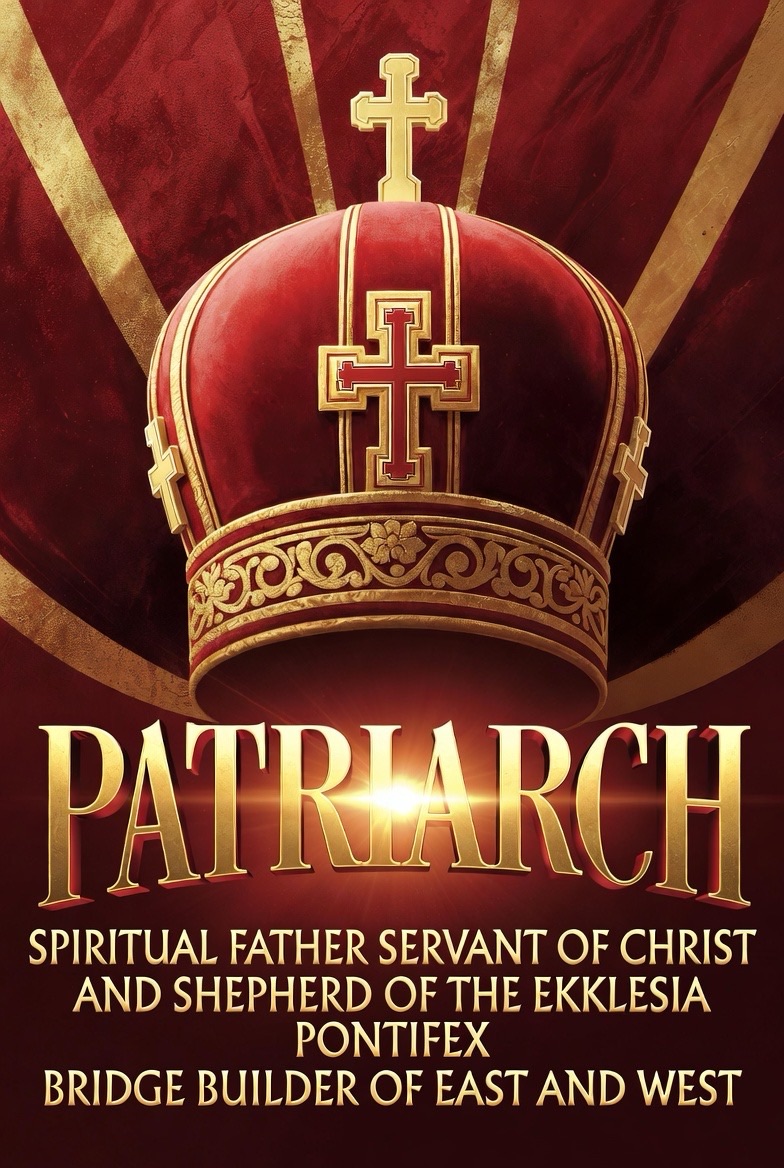
✠ APOSTOLIC STUDY
The Church, the Patriarchates, and the Question of America
By ✠ Patriarch Pontifex Tikhon II – Кевин Филд
From the beginning, the Church founded by our Lord Jesus Christ was established through the Apostles and their successors as a living body of faith spread throughout the world. Christ Himself did not establish a worldly government or centralized empire. Instead, He entrusted His Church to the Apostles, commanding them to go into all nations, preach the Gospel, baptize, and establish the Ekklesia wherever the faith was received.
The Apostolic Church developed according to a clear pattern that can be seen in the Scriptures and the earliest life of the Church. The Apostles ordained bishops and elders in cities and regions so that the faithful would always have shepherds to guard the faith, celebrate the Eucharist, and guide the people of God. Saint Paul instructed Titus to appoint elders in every city, showing that the Church was always meant to be locally shepherded while remaining united in the same apostolic faith.
The first center of the Church was Jerusalem, where Saint James the Just served as bishop and presided over the early Christian community. From Jerusalem the Gospel spread outward into the great cities of the ancient world. Rome, Antioch, and Alexandria became major apostolic centers where the faith took root and grew through the leadership of bishops who were successors of the Apostles.
As the Church expanded throughout the world, these great centers gradually became known as patriarchates. This development was not about power or worldly authority, but about responsibility and pastoral care. Each patriarch served as a guardian of the faith within a particular region while remaining in communion with the other patriarchs and bishops of the Church.
Thus the Church developed a patriarchal structure across the Christian world. Jerusalem, Rome, Antioch, Alexandria, and later Constantinople served as major patriarchal sees. Each of these centers shepherded believers in their territories while remaining united in the same faith, the same Eucharist, and the same apostolic tradition.
This system reflected the true nature of the Church: one faith expressed through many local communities. The Church was never meant to be divided into competing bodies, but rather to function as a living communion of churches bound together through Christ.
Whenever the Gospel entered a new land, the same apostolic pattern was followed. Missionaries preached Christ, baptized new believers, ordained clergy, and established churches. As these communities matured and grew stronger, they developed their own local hierarchies. Over time, some regions became self-governing churches or patriarchates while still remaining faithful to the apostolic tradition.
This brings us to an important reflection for our own time. If the ancient apostolic pattern were followed strictly according to geography and mission, large regions of the world would naturally develop their own local leadership once the Church became firmly established in those lands. The early Church always sought to establish local shepherds who understood the people, culture, and mission of their region.
The history of Orthodoxy in North America reflects this same vision. The great missionary bishop Saint Tikhon saw America as a mission field that would eventually grow into a unified local church. His vision was that the Church in America would mature and eventually stand as a strong apostolic presence rooted in the land while remaining faithful to the universal faith of the Church.
The key principle of the apostolic structure is that the Church is both universal and local. The universal Church is the Body of Christ, united through the Holy Spirit and the apostolic faith. The local church is the visible community of believers gathered around their bishop and celebrating the Holy Eucharist.
When these two realities remain in harmony, the Church flourishes. When they become distorted by pride, competition, or worldly ambition, division and confusion can arise.
Therefore the true purpose of bishops, patriarchs, and clergy is not to build personal authority or institutions of power. Their calling is to guard the faith of Christ, shepherd the people of God, and preserve the apostolic tradition handed down from the beginning.
Christ Himself taught that those who lead His people must be servants. The greatest in the Church is not the one with the highest title, but the one who faithfully serves Christ and His flock with humility and love.
In every generation the Church must return to this apostolic understanding. Structures and titles have meaning only when they serve the Gospel and help guide the faithful toward Christ.
The Church does not belong to men. The Church belongs to Christ alone. He is the Head of the Church, the High Priest of the Eucharist, and the true Shepherd of His people.
Wherever the apostolic faith is preserved, wherever the Eucharist is celebrated with reverence, and wherever the Gospel of Christ is proclaimed in truth, there the Church continues to live.
Our task as shepherds is therefore simple but sacred: to guard the faith, to guide the faithful, and to lead all people toward the Kingdom of God.
✠ Patriarch Pontifex Tikhon II – Кевин Филд
The One Holy Apostolic Ekklesia of Christ
 PATRIARCH PONTIFEX TIKHON II ( Кевин Филд ) The Apostolic Newsletter
Leave a comment